Utpal Rakshit, PhD
Assistant Professor, Department of English, Samuktala Sidhu Kanhu College, West Bengal, India.
DOI: To be assigned
[Publication History: Received: 08 Apr 2025. Accepted: 21 July 2025. Published: 25 July 2025]

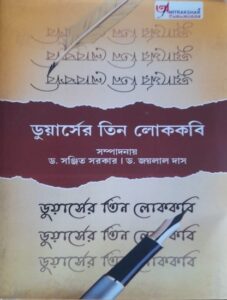
About the Book: Dooarser Tin Lokokobi (2024),
Edited by Dr. Sanjit Sarkar and Dr. Joylal Das,
Amitrakshar Publisher, Kolkata
ISBN: 978-93-60008-535-3
No. of Pages: 342
Price: ₹ 400.00
Full HTML Text
The folk poems, the eternal wealth of Bengal, are on the verge of extinction today. The unmediated rhythms of village life and the down-to-earth spirit of the soil often remain marginalised in governing cultural discourses. We must extend our sincere appreciation to Dr. Sanjit Sarkar and Dr. Joylal Das for their editorial work on the Bangla volume Dooarser Tin Lokokobi (The Three Folk Poets of Dooars). It is not just a collection of folk poetry; it is a manifesto for folk justice, a corrective to literary exclusion, and a revival of the aesthetic-political agency of the marginal. The volume focuses on three self-taught and socioeconomically marginalised poets from the Dooars[i] region—Sudhir Chandra Pandit, Subal Chandra Sarkar, and Subal Chandra Pandit. None of them received formal education in literary arts, and yet, their mastery in capturing the pulse of their time through verse makes the work an extraordinary contribution to folk literature in India. This review aims to evaluate the aesthetic, sociopolitical, and ethnographic significance of the volume and foreground its critical importance in rethinking the boundaries of literary value.
The three poets featured in the collection shared a common struggle against poverty, displacement, and cultural erasure. Their works emerge not from privileged literary circles but from direct encounters with suffering, displacement due to the partition of Bengal, migration, communal violence, and agrarian distress. For instance, Sudhir Chandra Pandit, a refugee following the Partition, spent his life writing and selling his poems across haats (weekly village markets) of Bengal and Assam. His corpus, estimated to include over 450 poems, remains only partially preserved, with 45 poems compiled in this edition. His subjects range from romantic tragedies to political commentaries and from crime reportage to mythological retellings. His work becomes a living document of what Walter Benjamin (1968) once called the “unofficial” history of the oppressed. Similarly, Subal Chandra Sarkar (only 8 poems are archived) and Subal Chandra Pandit (only 4 poems are archived) wrote about events that shaped contemporary rural life- from dowry, deaths, and agrarian revolts to the devastating consequences of the Nandigram-Singur conflict of 2007-2008 and the global COVID-19 pandemic. In this way, the volume constructs a counter-archive that captures folk epistemologies and marginal knowledge systems ignored by mainstream media and literature.
Equally important is the book’s attention to print practices and oral economies. The poets often self-funded their publications, sold them in rural markets, or performed them using rented microphones and rickshaws. Such grassroots literary economies complicate traditional publication models and resemble the ‘vernacular modernities’ proposed by Partha Chatterjee (1993), where the local and the indigenous coexist with modern forms of dissemination. The poems were printed in quarto, cheaply bound, and sold to villagers, who recited them collectively. The circulation of these texts highlights alternative networks of literacy and cultural participation, outside the confines of formal publishing, emphasising the resilience of folk media against the erasures of digital and neoliberal cultural industries. Despite their lack of formal education, the poets demonstrate remarkable command over narrative structure and emotive language. Their poetry, often performed with the accompaniment of a tambourine or foot drum, revives the performative traditions of Bengali ballads. A characteristic device used is the Dhuwa or Dhrupad– a refrain that lends rhythm and cohesion to the narrative, paralleling what English prosody identifies as repetition (Das & Sarkar, 2024). This oral stylistic foundation places the poets within the ‘bhadralok’-subaltern dichotomy, where the poetic is no longer judged by refined meter or Sanskritised diction, but by its capacity to represent collective experience. The book underlines how these poems served as evening entertainment in village gatherings, not just texts but performative rituals that animated the hopes, frustrations, and shared wisdom of rural communities.
A major strength of the anthology lies in the diversity of themes tackled by the poets. From the poetry of Sudhir Chandra Pandit, we encounter poems like “Ami Tin Khuner Asami” (I Am the Accused of Three Murders) and “Pitar Hate Khun” (Father Committing Murder), which address the violence bred by poverty and social breakdown. These are not abstract meditations but concrete, gritty engagements with the real, reminding of Bertolt Brecht’s call for a theatre of realism. Subal Chandra Sarkar’s “Ravan Badh ba Sita Uddhar” (Killing of Ravana or Rescue of Sita) reveals a mythopoetic sensibility, retelling the Ramayana in colloquial idiom, while “Bloody Nandigram” chronicles the trauma of state-sponsored violence[ii] during land acquisition protests. These compositions resonate with what historian Ranajit Guha called “the small voice of history” (Guha, 2009), capturing human costs behind statist narratives of development or nationalism. In the case of Subal Chandra Pandit, we encounter poems like “Corona Saavdhan” (Beware of Corona), which try to raise health awareness among rural populations during the pandemic. Here, poetry is fashioned not for aesthetic delight but as a tool for public pedagogy, bearing semblance to the Gramscian idea of the organic intellectual.
One of the boldest contributions of Dooarser Tin Lokokobi is its challenge to elitist notions of literary value. The volume questions why certain texts and authors make it into syllabi, anthologies, and literary festivals, while others languish in oblivion. The three poets in question do not write in refined Bengali or use metaphysical conceits. Yet, their poems offer sharp sociological insight, ethical critique, and cultural preservation. Their works are reminiscent of the Lok Shahitya tradition, which is rural, anonymous, and often performative and which has historically been dismissed as “non-literary” by Sanskritised literary criticism (Chakrabarty, 2002). In reviving and preserving this tradition, Sarkar and Das’s editorial intervention becomes a political act of democratising the field of literary representation. In the framework of subaltern studies, the volume answers the call made by Ranajit Guha and his colleagues to retrieve historical consciousness from below (Guha, 1997, p. 40). The poets in this anthology offer what may be called a “subaltern poetics”[iii] or an aesthetic practice grounded in experience, trauma, and a rejection of elite literary hegemony. Their poetic expressions are not nostalgic folklore but urgent testimonies of survival in a stratified and politically fractured society. The simplicity of diction, the rhythmic orality, and the balladic structure imbue these verses with communal affect and mnemonic value. Spivak’s formulation (“Can the Subaltern Speak?”) is inverted here: the subaltern not only ‘speaks’ but sings, protests, documents, and mourns (Spivak, 1988, p. 66). Their poems serve as a kind of vernacular historiography, cataloguing events from political betrayal to domestic abuse, from social injustice to natural disasters.
The editors have done commendable work in contextualising the biographies of the poets and documenting the socio-historical background of the poems. However, one could argue that the critical apparatus remains underdeveloped. There is scope for richer annotation, comparative study with other regional traditions (like Baul or Bhatiyali[iv]), and a more expansive theoretical framing using caste, gender, or postcolonial lenses. The book also lacks detailed commentary on the intersection of folk poetry with contemporary Dalit or tribal narratives. Given that these poets operated on the margins of caste and class structures, such an analysis would enrich the volume’s contribution to intersectional literary studies. Nevertheless, Dooarser Tin Lokokobi is a landmark volume in the field of Bengali folk literature. It recuperates neglected voices and traditions from extinction and reasserts the political and aesthetic value of marginalised creativity. In a time when literary value is increasingly mediated by marketability and Anglophone cosmopolitanism, the book is a powerful reminder of the literary wealth embedded in rural and oral traditions. The poems here are not simply “texts” but living archives of people’s histories, their anxieties and resistances, their joys and ruptures. They challenge the dominant paradigms of what is considered literary and open up avenues for future research on subaltern aesthetics, orality, and regional modernities. Most importantly, the book makes a fervent appeal to literary scholars, policymakers, and educators alike: to recognise, preserve, and celebrate the poetics of the people. Such an appeal reverberates through the poetic renderings of Subal Pandit:
We speak of the folk poet’s pain and plight,
Neglected we are, neglected we are, out of sight.
No one comes when sorrow is near,
Our village life floats on a river of tear.
O my state Govt, my dear Govt, hear our cry,
Don’t let the roots of culture die.
The folk poet’s soul, deserves your steady hand,
To guard the songs of this fading land. (as cited in Sarkar & Das, 24; my trans.)
[i] ‘Dooars’ is a geographic region at the foothills of the eastern Himalayas covering districts like Jalpaiguri, Alipurduar of Bengal and extending into western Assam.
[ii] The Nandigram violence refers to the 2007 conflict in West Bengal over land acquisition for a proposed chemical hub (SEZ), leading to a police firing on the demonstrators of Bhoomi Raksha Committee that killed 14 villagers and injured many others.
[iii] Subaltern poetics states the aesthetic practices, narrative strategies, and expressive forms through which subaltern groups express their experiences, identities, resistance, and worldviews.
[iv] ‘Baul’ and ‘Bhatiyali’ are two different but fully rooted traditions of folk music in Bengal, each with its own philosophy, performance style, and cultural position.
Conflict of Interest: The authors have no conflict of interest.
Funding: No funding has been received by the authors for this research or/ and publication.
References
Benjamin, W. (1968). Theses on the Philosophy of History. In H. Arendt (Ed.), Illuminations (pp. 253–264). Schocken Books.
Chakrabarty, D. (2002). Habitations of Modernity: Essays in the Wake of Subaltern Studies. University of Chicago Press.
Chatterjee, P. (1993). The Nation and Its Fragments: Colonial and Postcolonial Histories. Princeton University Press.
Guha, R. (1988). On some aspects of the historiography of colonial India. In R. Guha & G. C. Spivak (Eds.), Selected subaltern studies (pp. 37–44). Oxford University Press.
Guha, R. (1997). History at the Limit of World-History. Columbia University Press.
Guha, R. (2009). The small voice of history (P. Chatterjee, Ed.). Permanent Black.
Sarkar, S., & Das, J. (Eds.). (2024). Dooarser Tin Lokokobi. Amitrakshar Publisher.
Spivak, G. C. (1988). Can the subaltern speak? In C. Nelson & L. Grossberg (Eds.), Marxism and the interpretation of culture (pp. 66–111). Macmillan.
About the Reviewer
Dr. Utpal Rakshit is an Assistant Professor of English at Samuktala Sidhu Kanhu College in West Bengal and a passionate scholar of Dalit and subaltern literatures. Besides his extensive teaching experience, he has published widely, edited notable academic volumes, and serves as a mentor through the National Mission for Mentoring (NMM) of the NCTE. His work connects classrooms, communities, and critical thought.